

Would it help to talk this through?
A certified counselor will go through your own numbers with you. The session is free and there is nothing to buy.
What a Debt Management Plan Is#
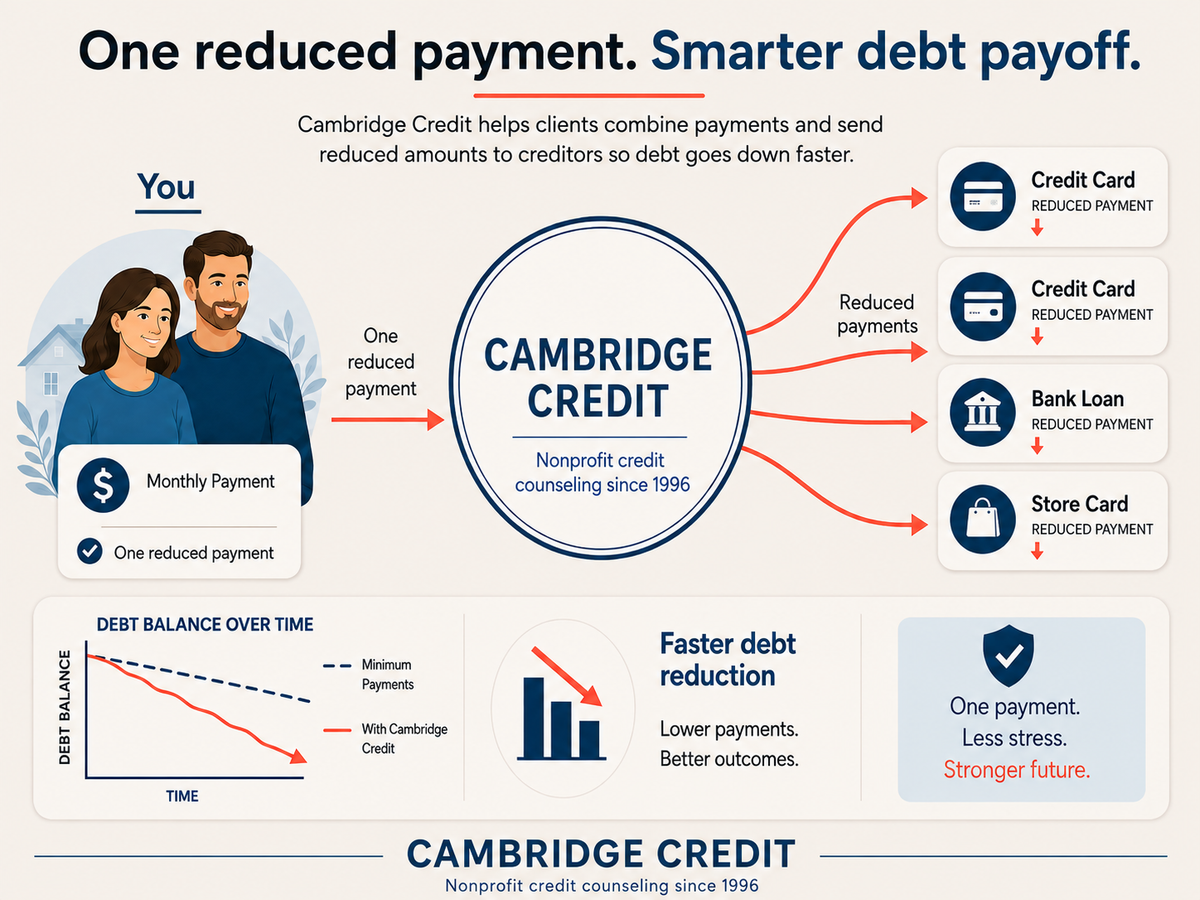
A debt management plan consolidates unsecured debts into one monthly payment administered by the counseling agency. It does not involve borrowing new money. Through Cambridge Credit Counseling, a debt management plan is set up by working directly with each of the client’s creditors, folding separate bills into a single monthly payment.
How the One Monthly Payment Works#
A person enrolled in a Cambridge Credit Counseling debt management plan makes one monthly payment to Cambridge. Cambridge then sends individual payments out to each creditor included in the plan on the client’s behalf. This is true whether you enroll through Cambridge Credit Counseling or another nonprofit agency offering a debt management plan.
Concessions Creditors Offer#
On a debt management plan, concessions such as reduced interest rates or waived fees are set by each creditor, not by the counseling agency. On Cambridge Credit Counseling’s plan, creditor benefits can include reducing interest rates, bringing past-due accounts current, and eliminating or reducing late and over-limit fees. Our typical client makes one simple, lower payment every month instead of paying all the accounts on their debt management plan separately over the course of the month. There are preset guidelines and concessions the credit card companies offer which we have programmed in our systems. There are no negotiations happening. We can present the benefits and concessions before you sign up for a debt management plan. In some cases concessions and benefits can vary based on the level of hardship in the budget. In some cases certain accounts may not be eligible for the concessions and benefits. Interest rate reductions on a Cambridge Credit Counseling plan generally take effect after three or four monthly payments, depending on the individual creditor’s own policy.
What a Debt Management Plan Is Not#
A debt management plan is not a loan, and Cambridge Credit Counseling does not lend money since it is a nonprofit agency. A debt management plan is also different from debt settlement. Debt settlement is an agreement between a creditor and a debtor in which the creditor accepts less than the full balance owed as payment in full. A debt management plan does not work that way, since the goal is to repay what is owed under revised terms rather than to settle for a reduced balance. It is also worth noting that a debt management plan is not the same thing as credit counseling itself, though setting one up is one possible outcome of a credit counseling session.
How Cambridge Credit Counseling Sets Up a Plan#
Cambridge Credit Counseling begins the process by having a counselor review your financial situation and the debts you want to include. From there, Cambridge provides an estimated monthly payment and an estimated time frame for becoming debt free. To find out whether you qualify, you take part in a one-on-one debt analysis with a nationally certified credit counselor. You do not have to enroll every card in the plan, and many people keep the card with the highest available credit limit outside the plan.
You Do Have Options Besides a Debt Management Plan#
Debt Management Programs are structured and endorsed by creditors to help those consumers who face significant financial difficulty. If you have consistently maintained your monthly payments, or have ever sent larger payments than required when extra funds were available, you may be barred by your creditors from participating in a debt management program, and the normal concessions extended through these programs would not apply to you. There are, however, several ways to accelerate the repayment of your debt on your own.
The first and most important step is to establish a budget. It will help you to calculate your disposable income, so you can see how much you can put toward your debt. Keep in mind that you should be dedicating some of this money toward building savings. It is recommended that you have 3 to 6 months’ worth of income in savings; however, any amount you are able to save is good. You also need to stop incurring debt. One of the easiest ways to achieve this is to close your credit card accounts, though you may wish to leave an account with a low interest rate open for emergency use.
Strategies to get out of debt
- Negotiate with creditors: creditors won’t lower your interest rate without being asked. When you have a good repayment history, you’re in a good position to negotiate a lower interest rate. You can inform your creditors of lower offers you have received and request that they match or even beat these offers.
- Move high interest rate credit card balances to your low interest rate credit cards: for example, if you are being charged 21% on a specific account, move the balance to a credit card charging 12%.
- Target high interest cards: continue to send more than the minimum payments to your credit cards while putting the bulk of your funds toward the credit card with the highest interest rate. When this account has been repaid, apply those funds to the card with the next highest interest rate, and continue until all of your cards are paid off.
- Make extra payments on credit cards: when you make your credit card payments, send an additional $5.00 or $10.00 extra to save on interest charges that accumulate if you leave a large amount in the balance.
Using a home equity loan to pay off credit card debt is not the cheapest or safest way to pay off your credit cards. Credit card debt is unsecured. By converting it into a secured debt, you run the risk of losing your home should you fall behind on the equity loan payments.
Fees on a Debt Management Plan#
The counseling session is free. If you choose a debt management plan, there is a fee to set it up and a monthly fee, and we explain both before you decide whether to enroll. Each state sets a ceiling on those fees, and Cambridge Credit Counseling sets the fee according to what a household can afford within that ceiling. About one client in four has it reduced by their counselor.
Fees vary from state to state and from agency to agency. Cambridge Credit Counseling bases its own fees on the rules set by the client’s state.
How Credit Cards Work#
Types of Credit Cards
Banks issue credit cards for people with a variety of different financial profiles. For example, a person with a 750 credit score will qualify for a credit card with a lower annual percentage rate, a high spending limit, and maybe even no annual fees. Conversely, a person with a 600 credit score will likely pay a much higher interest rate, have a lower spending limit, and will probably have to pay an annual fee. It all comes down to the level of risk that the bank is taking when extending credit.
Banks will even offer cards to consumers who have a very poor credit history in order to help them rebuild their credit. These cards will most likely have a very high interest rate and a very low spending limit. Another card that banks offer consumers with a poor credit history is a secured card. These cards are secured by funds that you deposit into the card’s account, but they function like a normal credit card in terms of how you use them to purchase items, and they are primarily used to help build a person’s credit history.
Are credit card fees and charges avoidable?
Fees and interest are how the banks make money on credit card accounts, and they can vary quite a bit from card to card. Many credit card fees, and even interest charges, can be avoided by always making your payments on time and in the correct amounts, and making sure that you always stay within your credit limit.
Cambridge Credit Counseling recommends that you pay your credit card balances in full every month. If you do this, you will avoid paying interest on the amount of money that you used for that period. If you cannot afford to do so, you must at least pay the minimum monthly payment due prior to the due date to avoid late fees. At the very least, read the fee and interest rate disclosures on any card offer to make sure that you’re getting a fair deal.
What to Do Next#
If you want to know whether a debt management plan fits your situation, Cambridge Credit Counseling offers a free financial assessment as part of enrolling in its plan. During this session, a counselor reviews your debts and gives you an estimated monthly payment and time frame before you decide on anything.
What a debt management plan actually does
- Interest paidOur typical client would have paid $44,676 in interest on their own, against $4,936 in interest and our fees on the plan
- Interest ratesCreditors cut them from 28.99% to 7% on average
- Monthly payment35.7% lower on average, or 31.1% after our fees
- Time to pay off38 months on average, against a 52-month plan
Cambridge Credit Counseling client data: 6,809 enrollments in the year to 30 June 2026, and 1,434 plan completions in 2025. Prepared by Brian Vosburgh, Director of DMP Operations, September 2026.
Your own result depends on your debts, your budget and what your creditors agree to.
Common questions
Is a debt management plan a loan?
No. A debt management plan consolidates unsecured debts into one monthly payment administered by a counseling agency, but it does not involve borrowing new money. Cambridge Credit Counseling is a nonprofit agency that does not lend money.
Who decides if my interest rate gets reduced?
Concessions such as reduced interest rates or waived fees generally follow preset guidelines set by each creditor. The counseling agency does not set these terms. On Cambridge Credit Counseling's plan, there are no negotiations happening, and rate reductions generally start after three or four monthly payments, depending on the creditor's policy. Our typical client makes one simple, lower payment every month instead of paying all the accounts on their debt management plan separately over the course of the month. In some cases concessions and benefits can vary based on the level of hardship in the budget. In some cases certain accounts may not be eligible for the concessions and benefits.
How is a debt management plan different from debt settlement?
Debt settlement is an agreement where a creditor accepts less than the full balance owed as payment in full. A debt management plan works differently, since it is built around repaying what is owed under revised terms rather than settling for a lower amount.
Do I have to include every credit card in the plan?
No. When enrolling in a Cambridge Credit Counseling debt management plan, you do not have to include every card. Many people choose to keep the card with the highest available credit limit outside the plan.
How does Cambridge Credit Counseling set up a debt management plan?
A Cambridge Credit Counseling counselor first reviews your financial situation and the debts you want included. Cambridge then gives you an estimated monthly payment and an estimated time frame for becoming debt free, based on a one-on-one debt analysis with a certified counselor.
Where this information comes from
- Credit Card Bill Collectors | Cambridge Credit cambridge-credit.org Checked 2026-08-04.
- Debt Management Plans | Cambridge Credit cambridge-credit.org Checked 2026-08-04.
- Shopping for a Home | Cambridge Credit cambridge-credit.org Checked 2026-08-04.
- Cambridge Credit Counseling, confirmed by President and CEO Christopher Viale in August 2026. Checked 2026-08-24.
- Disclosures, State Licenses | Cambridge Credit cambridge-credit.org Checked 2026-08-04.
- Financial Literacy | Cambridge Credit cambridge-credit.org Checked 2026-08-04.
- Cambridge Credit Counseling cambridge-credit.org Checked 2026-08-04.
- Federal Trade Commission, How To Get Out of Debt consumer.ftc.gov Checked 2026-09-18.
- How To Get Out of Debt, Federal Trade Commission consumer.ftc.gov Checked 2026-08-28.
- What is a Charge-Off? | Cambridge Credit cambridge-credit.org Checked 2026-08-04.
- What is Credit Counseling? | Cambridge Credit cambridge-credit.org Checked 2026-08-04.
- Christopher Viale, President and Chief Executive Officer, Cambridge Credit Counseling Corp, written brief by email 2 September 2026. Checked 2026-09-02.
- Cambridge Credit Counseling cambridge-credit.org Checked 2026-08-04.
- Consumer Financial Protection Bureau, What is the difference between credit counseling and debt settlement, debt consolidation, or credit repair? consumerfinance.gov Checked 2026-09-18.
- About Cambridge Credit Counseling cambridge-credit.org Checked 2026-08-04.
- Cambridge Credit Counseling cambridge-credit.org Checked 2026-08-04.
- What is Debt Settlement? | Cambridge Credit cambridge-credit.org Checked 2026-08-04.
- Student Loan Debt Consolidation | Cambridge Credit cambridge-credit.org Checked 2026-08-04.
- Cambridge Credit Counseling compliance guidance Checked 2026-08-07.
- industry definition, NFCC nfcc.org Checked 2026-08-28.
- Federal Family Education Loans (FFEL) | Cambridge Credit cambridge-credit.org Checked 2026-08-04.