

When you compare debt settlement with a Cambridge Credit Counseling debt management plan, the real difference is not just what each costs today. It is what each does to your balance, your creditors, and your credit over time. Debt settlement asks a creditor to accept less than you owe, but there is no legal right to settlement, so lawsuits and growing balances are possible, and forgiven debt can be taxed. A Cambridge Credit Counseling debt management plan works differently: you make one monthly payment to us, we work with your creditors rather than against them, and the plan is built to pay your balances in full, with the concessions your creditors have put in place.
Would it help to talk this through?
A certified counselor will go through your own numbers with you. The session is free and there is nothing to buy.
What Debt Settlement Means Legally#
In the United States, there is no legal right to settle a debt. A creditor is not required to accept any settlement offer a consumer makes.
How Debt Settlement Actually Works#
On a typical debt settlement program, you pay money into a special account periodically until enough has built up to offer a creditor a lump-sum settlement on an enrolled account. While that money is accumulating, no monthly payments are being made on your accounts, so they fall past due and age toward charge-off. During this non-payment period, late fees, possible over-limit fees, and penalty interest rates are often charged, so the balances on the accounts increase. Debt settlement programs generally do not work with your creditors in an agreeable way. They generally disconnect the relationship between you and the creditor, often through a cease-and-desist letter, which stops the creditor from contacting you directly, except where the creditor sues you for non-payment.
The Financial Risks of Debt Settlement#
While you set money aside for a possible settlement, interest and late fees continue to be assessed, so the balance can keep growing. If a creditor later forgives part of the principal, that forgiven amount is generally reported to the IRS and to you on a Form 1099, and it is added to your taxable income unless you are insolvent. Debt settlement fees are generally charged at the point of a successful settlement and can range from 15 percent to 30 percent of the savings or of the settled amount. By the time a settlement is reached, many balances have grown enough that the settlement company’s fees plus the settled amount can come close to the original debt owed at enrollment, even though a successful settlement itself can range from 30 percent to 60 percent of that grown balance.
How a Debt Management Plan Works#
A debt management plan is not credit counseling itself, though setting one up is one possible outcome of a credit counseling session with Cambridge Credit Counseling. On a Cambridge Credit Counseling debt management plan, you make one monthly payment to us, and we send payments out to each creditor included in the plan. Cambridge Credit Counseling works with your creditors to obtain the benefits they are willing to extend, rather than working against them, and your balances are paid in full with the concessions your creditors have put in place. Almost all of these benefits are preset guidelines that creditors have established for debt management agencies to follow, so a plan is not a negotiation. Our counselors only recommend a plan when it is in your best interest, and there is never an obligation to enroll after a counseling session.
Creditor Concessions on a Debt Management Plan#
On a debt management plan, concessions follow preset guidelines set by your creditors, not by Cambridge Credit Counseling. In some cases they can vary based on the level of hardship in the budget, and certain accounts may not be eligible for them. Possible concessions include a reduced interest rate, a reduced monthly payment, waived past-due or over-limit fees, and re-aging a past-due account back to current status after three months of payments.
What Happens to Your Credit#
The period of non-payment on a debt settlement program has a deep negative impact on your credit score and on your future cost of borrowing. A Cambridge Credit Counseling debt management plan may adversely affect your credit, though the effect may be temporary as you remain committed to making monthly payments through your Debt Management Plan. That is generally because the accounts you enroll are closed. How large that impact is depends on how many accounts you enroll, how long they have been open, and what other accounts appear on your credit report. Over the long term, the impact of a debt management plan is generally very positive, because you are not defaulting and you are paying your debts in full. As long as payments are made on time, the accounts run current, and credit scoring models treat that as positive.
Core Differences at a Glance#
| Feature | Debt Settlement | Debt Management Plan |
|---|---|---|
| Legal standing | No legal right to settle a debt; a creditor is not required to accept an offer | Consumer voluntarily enrolls after a one-on-one debt analysis; there is never an obligation to join |
| How the balance gets paid | Creditor may accept less than owed, but only after balances have often grown | Balance is paid in full, with concessions creditors have agreed to extend |
| Relationship with creditors | Often disconnected, sometimes through a cease-and-desist letter | Cambridge Credit Counseling works with creditors to obtain preset benefits, not against them |
| Risk if payments stop | Nonpayment may lead creditors to raise charges or pursue collection activity, including lawsuits | One monthly payment is sent to Cambridge Credit Counseling, which forwards payments to each creditor on the plan |
| Possible tax impact | Forgiven principal is generally reported to the IRS and counted as taxable income | No debt forgiveness occurs, so this tax rule does not apply |
| Credit impact | The non-payment period has a deep negative impact on credit scores | An initial dip is possible when accounts close, but on-time payments generally help credit over the long term |
Fees to Expect on a Debt Management Plan#
The counseling session is free. If you choose a Cambridge Credit Counseling debt management plan, there is a fee to set it up and a monthly fee, and we explain both before you decide whether to enroll. Cambridge Credit Counseling sets each fee according to what a household can afford within its state’s maximum, and about one client in four has the fee reduced by their counselor. By comparison, debt settlement fees are generally charged as a percentage, typically 15 to 30 percent of the savings or of the settled amount, once a settlement is reached, and that percentage is applied to a balance that has often grown since enrollment.
Where to Learn More#
The Consumer Financial Protection Bureau publishes guidance on the difference between credit counseling, debt settlement, debt consolidation, and credit repair, which can help you compare options before deciding.
What to Do Next#
To find out whether a debt management plan could help your situation, Cambridge Credit Counseling offers a personalized, one-on-one debt analysis with a nationally certified credit counselor, along with a free financial assessment. There is never any obligation to enroll after this session. A debt settlement evaluation is also generally free and creates no obligation, but a nonprofit credit counseling session is not designed to sell you anything.
What a debt management plan actually does
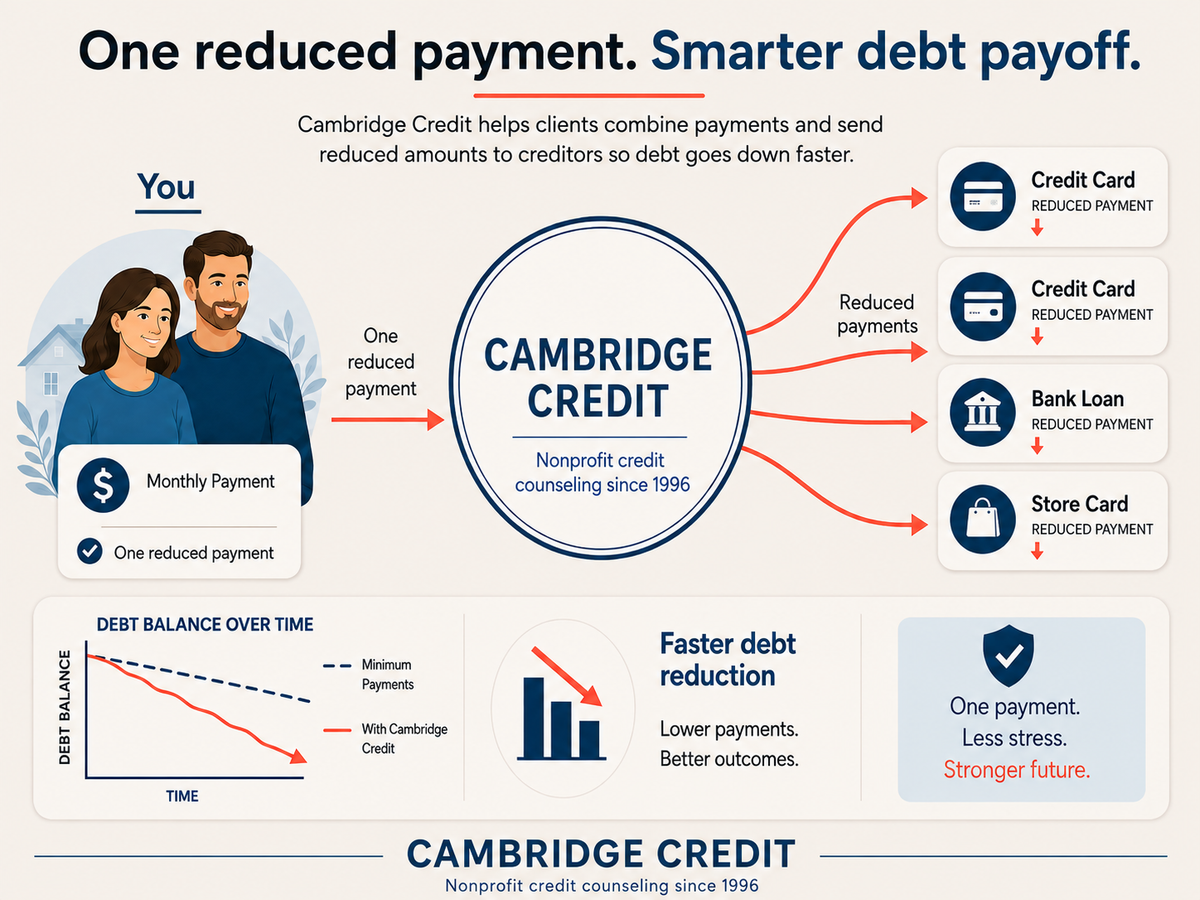
- Interest paidOur typical client would have paid $44,676 in interest on their own, against $4,936 in interest and our fees on the plan
- Interest ratesCreditors cut them from 28.99% to 7% on average
- Monthly payment35.7% lower on average, or 31.1% after our fees
- Time to pay off38 months on average, against a 52-month plan
Cambridge Credit Counseling client data: 6,809 enrollments in the year to 30 June 2026, and 1,434 plan completions in 2025. Prepared by Brian Vosburgh, Director of DMP Operations, September 2026.
Your own result depends on your debts, your budget and what your creditors agree to.
Common questions
Is it legal to try to settle a debt for less than I owe?
Yes, but there is no legal right to settle a debt in the United States. A creditor can refuse any settlement offer you make.
Will my balance grow while I save up for a settlement?
It can. Interest and late fees continue to be assessed on the debt while you set money aside, and no payments are being made on the account, so the balance you owe may keep increasing.
Is forgiven debt from a settlement taxable?
It can be. If $600 or more of the principal is forgiven, the creditor sends a Form 1099 to the IRS and to you, and the forgiven amount is generally added to your taxable income unless you are insolvent.
How do payments work on a debt management plan?
You make one monthly payment to Cambridge Credit Counseling, and we send payments out to each of your creditors included in the plan. We work with your creditors to obtain the benefits they are willing to extend, and your balances are paid in full.
What fees does a Cambridge Credit Counseling debt management plan charge?
Fees vary by state. A Cambridge Credit Counseling debt management plan has a setup fee and a monthly fee, set within your state's limits according to what a household can afford, and about one client in four has the fee reduced by their counselor. We explain the fees during your free counseling session, before you decide whether to enroll.
Where this information comes from
- Disclosures, State Licenses | Cambridge Credit cambridge-credit.org Checked 2026-08-04.
- Cambridge Credit Counseling compliance guidance Checked 2026-08-07.
- Debt Management Plans | Cambridge Credit cambridge-credit.org Checked 2026-08-04.
- Cambridge Credit Counseling, confirmed by President and CEO Christopher Viale in August 2026. Checked 2026-08-24.
- Financial Literacy | Cambridge Credit cambridge-credit.org Checked 2026-08-04.
- CFPB consumerfinance.gov Checked 2026-08-28.
- What is Debt Settlement? | Cambridge Credit cambridge-credit.org Checked 2026-08-04.
- Debt Snowball vs. Debt Avalanche | Cambridge Credit cambridge-credit.org Checked 2026-08-04.
- Federal Trade Commission, How To Get Out of Debt consumer.ftc.gov Checked 2026-09-18.
- How To Get Out of Debt, Federal Trade Commission consumer.ftc.gov Checked 2026-08-28.
- Consumer Financial Protection Bureau, What is a debt relief program and how do I know if I should use one? consumerfinance.gov Checked 2026-09-18.
- What is a 401k? | Cambridge Credit cambridge-credit.org Checked 2026-08-04.
- What is a Charge-Off? | Cambridge Credit cambridge-credit.org Checked 2026-08-04.
- What is Credit Counseling? | Cambridge Credit cambridge-credit.org Checked 2026-08-04.
- About Cambridge Credit Counseling cambridge-credit.org Checked 2026-08-04.
- Consumer Financial Protection Bureau, I’ve seen a lot of advertisements for companies that consolidate credit card debt. Are these legitimate? consumerfinance.gov Checked 2026-09-18.
- Consumer Financial Protection Bureau, What is the difference between credit counseling and debt settlement, debt consolidation, or credit repair? consumerfinance.gov Checked 2026-09-18.
- Cambridge Credit Counseling cambridge-credit.org Checked 2026-08-04.