

Credit counseling and debt settlement are two different ways to deal with unsecured debt, and they work very differently. A credit counseling session with Cambridge Credit Counseling is free and creates no obligation to do anything afterward. A debt settlement evaluation is also usually free and creates no obligation, but the settlement program itself is a paid service, just as our debt management plan is a paid service once you enroll. The real difference is not which one is free to look into. It is what each program does to your accounts, what it costs over time, and whether it works with your creditors or against them.
Would it help to talk this through?
A certified counselor will go through your own numbers with you. The session is free and there is nothing to buy.
What Credit Counseling Is#
Cambridge Credit Counseling looks at your full financial picture, including your income, expenses, and debts, and we offer this service for free to consumers who are struggling to pay credit card and other unsecured bills. A credit counseling session does not automatically create a debt management plan. Establishing a plan is just one possible outcome of the session, and there is never any obligation to enroll in one afterward. To find out whether a plan could help, a consumer completes a personalized, one-on-one debt analysis with one of our nationally certified counselors. If you do enroll, a plan has fees, and we explain them before you decide; they are based on what your household can afford and within the maximum your state allows.
A debt management plan works with your creditors to obtain the benefits they are willing to extend to their customers. The approach is not adversarial, and our counselors can present the benefits and concessions before you sign up for a plan. A plan consolidates the accounts you agree to enroll into a single structured payment made to Cambridge, and we send notifications called proposals to each enrolled account to secure those benefits. Creditor benefits on a plan can include a reduced interest rate, a reduced monthly payment, waived late and over-limit fees where an account is behind or over its limit, and the ability to bring a past-due account back to current after three months of payments. A plan is not a negotiation. Almost all of the benefits are preset guidelines that creditors have already established for debt management agencies to follow, and under a plan your balances are paid in full, with those concessions in place.
What Debt Settlement Is#
Debt settlement is a service that negotiates with creditors to pay less than the full balance owed. The Consumer Financial Protection Bureau treats debt settlement as a different service from credit counseling. Debt settlement is typically offered by for-profit companies, though a few large nonprofit agencies now offer it too. Cambridge Credit Counseling does not offer debt settlement in any form.
On a debt settlement program, you pay money into a special account periodically until enough has accumulated to offer a compromise and settlement on an enrolled account. While that money accumulates, no monthly payments are being made on your accounts, so those accounts fall past due and age through delinquency toward charge-off. During this non-payment period, late fees, possible over-limit fees and penalty interest rates are charged, so the balances on the accounts increase. This period of non-payment generally has a deep negative impact on a consumer’s credit score and on their future cost of borrowing.
Debt settlement programs generally do not work with a consumer’s creditors in an agreeable way. They generally disconnect the relationship between the consumer and the creditor, often through a cease-and-desist letter, which puts the creditor in a position where it cannot communicate with the borrower. A cease-and-desist letter does stop collection activity, except where the creditor sues the consumer for non-payment over time.
There is no legal right to settle a debt in the United States, and a creditor is not obligated to accept a settlement offer. Successful settlements can range from 30 percent to 60 percent of the debt owed, but by the time a settlement is reached, many balances have grown to the point where the settlement company’s fees plus the settled amount can come close to the original debt owed at enrollment. Settlement fees are generally charged at the point of a successful settlement and can range from 15 percent to 30 percent of the savings or of the settled amount. For example, a consumer who settles a 10,000 dollar debt for 6,000 dollars and pays a 2,000 dollar fee has paid 8,000 dollars in total.
When a settlement results in savings of 600 dollars or more, not including accrued interest and fees, the creditor must send a Form 1099 to the IRS and the debtor, and the forgiven principal is added to the debtor’s taxable income unless the consumer is insolvent.
Key Differences#
- A credit counseling session with Cambridge Credit Counseling is free, and a debt settlement evaluation is generally free too. The difference shows up later: a Cambridge debt management plan’s fees are set within your state’s limits according to what you can afford, while debt settlement fees are generally charged at the point of settlement and can range from 15 percent to 30 percent of the savings or settled amount.
- A debt management plan works with your creditors to obtain benefits they are already willing to extend, and it pays your balances in full. A debt settlement program generally disconnects that relationship, often through a cease-and-desist letter, and aims to pay less than the full balance, though growing fees and balances during the waiting period can narrow that gap.
- Creditors on a debt management plan generally stop collection calls once payments begin and the account is brought back to current status, which simply doing nothing does not achieve.
- Staying current on a plan avoids further late payments and charge-offs, and paying the debt down while keeping accounts current rebuilds your payment history over time.
- On the balances and rates our clients actually brought us, those same debts would have cost 44,676 dollars in interest and taken 272 months to pay off at their original terms. On a debt management plan, the same clients are projected to pay 4,936 dollars in interest and our fees.
- A nonprofit agency’s fees are generally lower than a for-profit settlement company’s fees, both up front and over the life of the debt.
- The Consumer Financial Protection Bureau publishes guidance explaining the differences between credit counseling, debt settlement, debt consolidation, and credit repair, so you can compare these options before choosing one.
Risks to Consider#
- Every debt relief option carries some risk, and it helps to understand what each one can do to your credit and your accounts before you choose. Establishing a debt management plan through Cambridge Credit Counseling may adversely affect your credit, though the effect may be temporary as you remain committed to making monthly payments through your Debt Management Plan. Not paying your debts may lead creditors to increase finance charges or pursue collection activity, including litigation.
- A debt management plan can have an initial impact on your credit score, generally because the accounts you enroll are closed. How large that impact is depends on how many accounts you enroll, how long they have been open, and what other trade lines appear on your credit report. Because you are not defaulting and are paying your debts in full, the long-term credit impact of a plan is generally positive, since on-time payments are treated favorably by credit scoring models as your accounts run current.
- Using home equity to pay off credit card debt turns unsecured debt into debt secured by your home, which puts your home at risk. This is a separate strategy from both credit counseling and debt settlement, but it shows why it matters to understand how any debt relief approach changes your obligations.
- Because a debt settlement program is typically offered by for-profit companies and can involve a non-payment period, growing balances, and a taxable forgiven amount, and because a creditor is not obligated to accept a settlement offer, it helps to review Consumer Financial Protection Bureau guidance before deciding which approach fits your situation.
How Cambridge Credit Counseling Fits In#
Cambridge Credit Counseling is a 501(c)(3) nonprofit agency established in 1996 that has provided credit counseling and financial literacy education to consumers nationwide since its founding. We offer credit counseling, debt management plans, housing counseling, student loan counseling, reverse mortgage counseling, and bankruptcy counseling. We are approved by the U.S. Department of Housing and Urban Development to provide housing counseling nationwide, accredited to the Financial Counseling Association of America’s Code of Practice, and a member of the National Foundation for Credit Counseling. These accreditations and approvals, not any single membership, are what back up how we operate.
What to Do Next#
If you want to understand your options before deciding between credit counseling and debt settlement, Cambridge Credit Counseling offers a free credit counseling session. A certified counselor can walk through your budget and debts with you, explain what a debt management plan would cost in your situation, and let you know whether it might be a fit, with no obligation to enroll.
What a debt management plan actually does
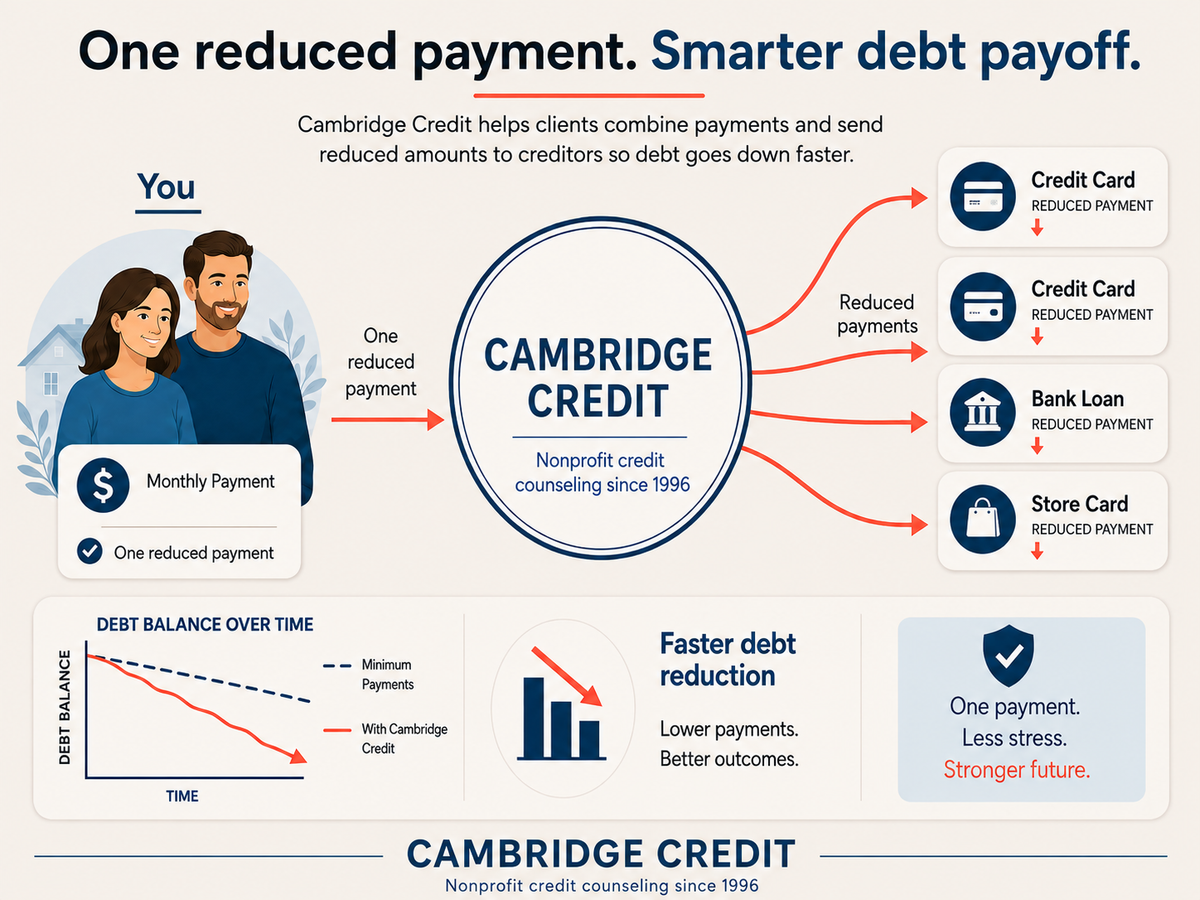
- Interest paidOur typical client would have paid $44,676 in interest on their own, against $4,936 in interest and our fees on the plan
- Interest ratesCreditors cut them from 28.99% to 7% on average
- Monthly payment35.7% lower on average, or 31.1% after our fees
- Time to pay off38 months on average, against a 52-month plan
Cambridge Credit Counseling client data: 6,809 enrollments in the year to 30 June 2026, and 1,434 plan completions in 2025. Prepared by Brian Vosburgh, Director of DMP Operations, September 2026.
Your own result depends on your debts, your budget and what your creditors agree to.
Common questions
Is credit counseling from Cambridge Credit Counseling free?
Yes. Cambridge Credit Counseling provides credit counseling as a free service for consumers who are having difficulty paying credit card and other unsecured bills.
Do I have to enroll in a debt management plan after a counseling session?
No. There is never any obligation to enroll in a debt management plan after a credit counseling session with Cambridge Credit Counseling.
Who typically offers debt settlement services?
According to the Consumer Financial Protection Bureau, debt settlement is a different service from credit counseling. It is typically offered by for-profit companies, though a few large nonprofit agencies now offer it too. Cambridge Credit Counseling does not offer debt settlement in any form. A creditor is not obligated to accept a settlement offer, and interest and late fees keep adding to the balance while money is set aside for a future settlement.
Can a debt management plan affect my credit score?
Establishing a debt management plan through Cambridge Credit Counseling may adversely affect your credit, though the effect may be temporary as you remain committed to making monthly payments through your Debt Management Plan. Nonpayment of debt may lead creditors to increase finance and other charges or pursue collection activity, including litigation.
What certifications do Cambridge Credit Counseling's counselors hold?
Counselors at Cambridge Credit Counseling hold certifications including NFCC Certified Credit Counselor, HUD-Certified Housing Counselor, HUD-Approved Reverse Mortgage Counselor, and PFE Certified Debt Management Professional. We are also accredited to the Financial Counseling Association of America's Code of Practice and a 501(c)(3) nonprofit, and a member of the National Foundation for Credit Counseling.
Where this information comes from
- Cash-Out Refinancing | Cambridge Credit cambridge-credit.org Checked 2026-08-04.
- Disclosures, State Licenses | Cambridge Credit cambridge-credit.org Checked 2026-08-04.
- Best Credit Counseling Service | Cambridge Credit cambridge-credit.org Checked 2026-08-04.
- Debt Management Plans | Cambridge Credit cambridge-credit.org Checked 2026-08-04.
- About Cambridge Credit Counseling cambridge-credit.org Checked 2026-08-04.
- Cambridge Credit Counseling cambridge-credit.org Checked 2026-08-04.
- Cambridge Credit Counseling cambridge-credit.org Checked 2026-08-04.
- Credit Counseling Certifications | Cambridge Credit cambridge-credit.org Checked 2026-08-04.
- NFCC Member Agencies register nfcc.org Checked 2026-08-28.
- Credit Counselors - Housing Counselors | Cambridge Credit cambridge-credit.org Checked 2026-08-04.
- Financial Literacy | Cambridge Credit cambridge-credit.org Checked 2026-08-04.
- Frequently Asked Questions | Cambridge Credit cambridge-credit.org Checked 2026-08-04.
- Selecting a Consumer Credit Counseling Agency | Cambridge Credit cambridge-credit.org Checked 2026-08-04.
- CFPB consumerfinance.gov Checked 2026-08-28.
- Equal Credit Opportunity Act | Cambridge Credit cambridge-credit.org Checked 2026-08-04.
- Cambridge Credit Counseling, Marketing Advertisements Source Data, prepared by Brian Vosburgh, Director of DMP Operations, 1 September 2026. Checked 2026-09-02.
- Federal Trade Commission, How To Get Out of Debt consumer.ftc.gov Checked 2026-09-18.
- How To Get Out of Debt, Federal Trade Commission consumer.ftc.gov Checked 2026-08-28.
- Consumer Financial Protection Bureau, What is a debt relief program and how do I know if I should use one? consumerfinance.gov Checked 2026-09-18.
- What is Credit Counseling? | Cambridge Credit cambridge-credit.org Checked 2026-08-04.
- CFPB consumer guidance consumerfinance.gov Checked 2026-08-28.