

Would it help to talk this through?
A certified counselor will go through your own numbers with you. The session is free and there is nothing to buy.
Keeping Your Health Insurance With COBRA#
COBRA is a 1986 federal law that lets former workers continue their employer’s group health plan for up to 18 months after they leave a job. The worker pays for the coverage themselves, so it helps to compare the premium cost against your budget before you decide to use it.
If You Do Become Unemployed, Take Action#
- If you have children in college or in a private school, contact the financial aid office and inform them of your layoff. They may provide emergency financial aid so that your child’s education will not have to suffer.
- Don’t start selling stock, taking out loans or tapping retirement savings. There are hefty penalties for withdrawing money early from retirement accounts. You should do this only in extreme need.
- If you have stock options, ask your employer about the rights you retain to exercise them.
- Be sure you fully understand the terms of any severance package, including the terms of any medical benefits continuation. Sign up for COBRA and unemployment benefits if appropriate.
- Review employment benefits, including medical, dental coverage and life insurance. Take care of necessary annual checkups and examinations while you’re still covered.
- Dual-income couples should look into moving the entire family to one spouse’s plan.
- Take advantage of career counseling or job placement services. In addition to advice, they may provide money-saving services like resume preparation or the use of computer resources. There are also many online job services that you may consider using.
Your 401(k) Loan May Come Due Fast#
A 401(k) is an employer sponsored retirement plan that lets employees put part of their income into the plan without paying taxes on it right away. If you borrowed from your 401(k) and lose or change jobs before repaying it, the outstanding balance generally must be repaid before your last day on the job or within about 90 days. If it is not repaid in time, the amount becomes taxable, and the IRS adds a 10 percent penalty for early withdrawal if you are under age 59.5.
Budgeting Tips for Seasonal, Temporary, and Commission Workers#
Temporary workers, seasonal workers, and workers paid on commission all have to contend with uneven incomes. The most important thing a worker in this situation should do is to learn how to live within his or her means. This starts with a solid budget.
- Determine your average monthly income. Use your pay stubs, or estimate as well as you can, and consider all forms of income. This may mean creating different variations of your budget.
- Account for all of your monthly expenses: your monthly bills, then expenses like gasoline, groceries, and other necessary costs. Keep a journal of all your spending for at least three months to determine how much you actually spend each month and to show where wasteful spending can be eliminated.
- Save. A general rule of thumb is to save between four and six months of expenses; set your sights on four months first. If your employer does not deduct taxes from your paycheck, be certain that you also save enough for your tax bill. Try to save a minimum of 10% of each paycheck, or as much as you can, and pay yourself first.
Initial Budget vs. Adjusted Budget#
The more uneven your income is, the more flexible your budget must become. Check how well each expense fits into your lowest earning month, and see if you can find places to save now so you can make a bad month less difficult to handle down the road. Bringing your lunch to work, making coffee at home, clipping coupons, saving spare change in a jar, and carpooling are all money savers. Make an adjusted budget based on your new savings, and compare it to your initial budget to see how much more free cash you have available for saving and for unexpected expenses.
Protecting Your Mortgage#
Missing mortgage payments can put your home at risk of foreclosure, so it is important to contact your lender as soon as you know a payment may be late. Forbearance is a form of short term mortgage relief that may let you make lower payments for a while. Forbearance does not cancel what you owe, it simply changes when or how much you pay for a period of time. If a foreclosure does start, options like selling the home, a short sale where the home is sold for less than the amount owed with bank approval, or a deed in lieu of foreclosure where you give the property back to the lender, can help limit further damage to your credit.
Your Priorities: Shelter, Utilities, Food and Transportation#
Your priorities should be shelter, utilities, food and transportation, in that order. Your mortgage should be your first priority because delinquent payments can cause huge problems. Not only do you risk losing your home, you jeopardize your credit rating. If you rent, you may get a bit more leeway from landlords, but you should still give this payment precedence.
Utility companies may offer budget plans, installment programs or other accommodations. If you need to, contact the Salvation Army, the United Way and other social service agencies for help with food and clothing.
Auto finance companies and credit unions may allow hardship cases to defer a payment on an auto loan or lease. Interest will continue to accrue, however, and some lenders may charge an extra fee for this option.
Watch for Mortgage Relief Scams#
Under the Mortgage Assistance Relief Services (MARS) rule, it is illegal for any company to collect fees for mortgage relief services until an offer of relief has been made and accepted. If a company asks for payment before helping you, treat that as a warning sign.
Getting Your Finances Back in Order After a Death or Divorce#
If a life-changing event, such as divorce or the death of a spouse, happens in your life, your finances will probably be the last thing you’ll want to deal with. However uncomfortable or difficult it might be, this should be one of the first things you take care of. Enlist a trusted friend or family member to help organize insurance policies, monthly bills, mail and phone messages.
If you’ve fallen behind on your bills, contact your creditors as soon as possible and advise them of the situation. You should never miss a mortgage or rent payment to pay a credit card bill instead. The following list is a basic guide to help you prioritize your bills:
- Home expenses (mortgage or rent, health insurance, utilities, groceries etc.)
- Travel expenses (car payment, car insurance, gas, etc.)
- Debt (credit cards, student loans)
- Savings (pay yourself 10% out of every paycheck for savings)
- Other (restaurants, take out, clothing, etc.)
Depending on your circumstances, these websites may help:
- Social Security Administration: how to apply for benefits, the aid you can expect to receive, and how to contact them directly.
- Veterans Administration: links to veterans benefits and services.
- Women’s Institute for Financial Education (WIFE): a non-profit organization dedicated to providing financial education to women seeking financial independence.
- National Association of Personal Financial Advisors (NAPFA): since 1983, NAPFA has been working to establish a registry for fee-only advisors, who are compensated solely by their clients and do not accept commissions or compensation from financial institutions whose products they recommend.
If you had not been working before your life-changing event but are able to do so, you may want to consider returning to the workforce. Ask your friends and family if they know of any opportunities, attend job fairs in your area, or contact employment agencies and search firms.
Help With Food Costs Through WIC#
Lower income women who are pregnant, nursing, or who have children under age five may qualify for WIC, a Department of Agriculture nutrition program that provides milk, cereal, cheese, and other food items. WIC is not available to every household after a job loss, it depends on income and family situation.
My Spouse Lost Their Job. What Now?#
With the increasing necessity for households to maintain two incomes, the prospect of your spouse being laid off or let go can be downright terrifying. However, there are ways to weather the storm and make it through this difficult situation while maintaining your relationship.
- Call your state’s unemployment office. Unemployment insurance is temporary income for eligible workers who become unemployed through no fault of their own and who are ready, willing, and able to work. To qualify, you must have been employed for a minimum number of weeks in a job covered by your state’s policy. When you call, they will advise you of the proper procedures to follow.
- Give yourself a financial wellness checkup. The first step in developing any financial plan is to evaluate your current financial situation. To begin, determine your net worth: list your assets (home, cars, savings, investments, etc.) and your liabilities (mortgage, student loans, credit card debt, and so forth), then subtract the total value of your liabilities from the total value of your assets. Once the net worth has been calculated, the next step is to formulate a budget.
- Cut some of your expenses. Ask for higher deductibles on your auto and health insurance plans, which can reduce your monthly premium payments. Many insurance companies also offer discounts to customers who purchase more than one type of policy. Downgrade your cable TV package to eliminate channels you don’t watch, and review your phone bill to eliminate unnecessary extras.
Use All of Your Resources
Although it’s true that losing a job is a difficult thing, don’t panic. Your family and friends may be able to help, and you may have cash or assets that can be liquidated easily to get you through this emergency. If you have received a severance package or have a substantial amount of money saved in an emergency fund, consider pre-paying some bills. Many recurring bills can be pre-paid, including mortgages, property taxes, insurances (home, vehicle and life), and loans (such as student loans). Travel expenses such as tolls, registration, parking and public transportation can also be paid in advance. Pre-paying will help to alleviate some of the monthly expenses while your spouse is looking for a new position, and reduce the temptation to over-spend the money slated for emergencies.
Update Your Resume
Now is the time for both you and your spouse to update your resumes. If you want to change the format, there are many online resources available to help. Some of these include:
Stick Together
During a situation like this, it is more important than ever for a couple to stick together and stay positive. Discuss your fears with your spouse; chances are that their anxieties are similar. Take each fear individually and look at the worst-case scenario, and try to remember that almost every problem has a solution. A family is a team. Try not to argue with each other about things that you have no control over, and make your decisions based on what is best for the family.
Financial Stress and Your Health#
Financial stress can have major effects on your health. Being concerned about your finances is the best way to keep them under control, but it is important to recognize the point at which worrying about your finances progresses into stressing about your finances in an unhealthy way, and to understand the risks of continuing to foster financial stress in lieu of seeking help with your debts.
Two of the most common effects of financial stress are anxiety and depression. If you are behind financially and are feeling discouraged and hopeless or have feelings of constant worry and poor concentration, you may be seeing signs of one of these disorders. Other conditions that can be caused or worsened by financial stress include heart disease or heart attack, gastrointestinal problems, weight gain or loss, eating disorders, diabetes, insomnia, psoriasis, cancer, high blood pressure, and substance abuse. If any of these effects of stress are causing you duress, consult your physician immediately.
What can I do to prevent stress-related illnesses?
If you were laid off suddenly, sign up for unemployment services if you’re having difficulties with immediately finding new employment. Then take some time to freshen up your resume and spend a few hours a week searching for new prospects.
Be proactive. Write a budget and get your finances down on paper: see what you make, what your monthly responsibilities are, and what your debts are. Take small steps. Other tips for stress relief include talking to someone, deep breathing, meditation, yoga, exercise, listening to music, and eating a healthy snack. Remember, your health is your most valuable asset.
What to Do Next#
Job loss brings a lot of decisions at once, and it helps to handle them one step at a time. Contact your former employer about COBRA and your 401(k) loan terms, reach out to your mortgage lender before you miss a payment, and check with your local WIC office if you think your family may qualify. Cambridge Credit Counseling can help you look at your full financial picture and talk through your options.
What a debt management plan actually does
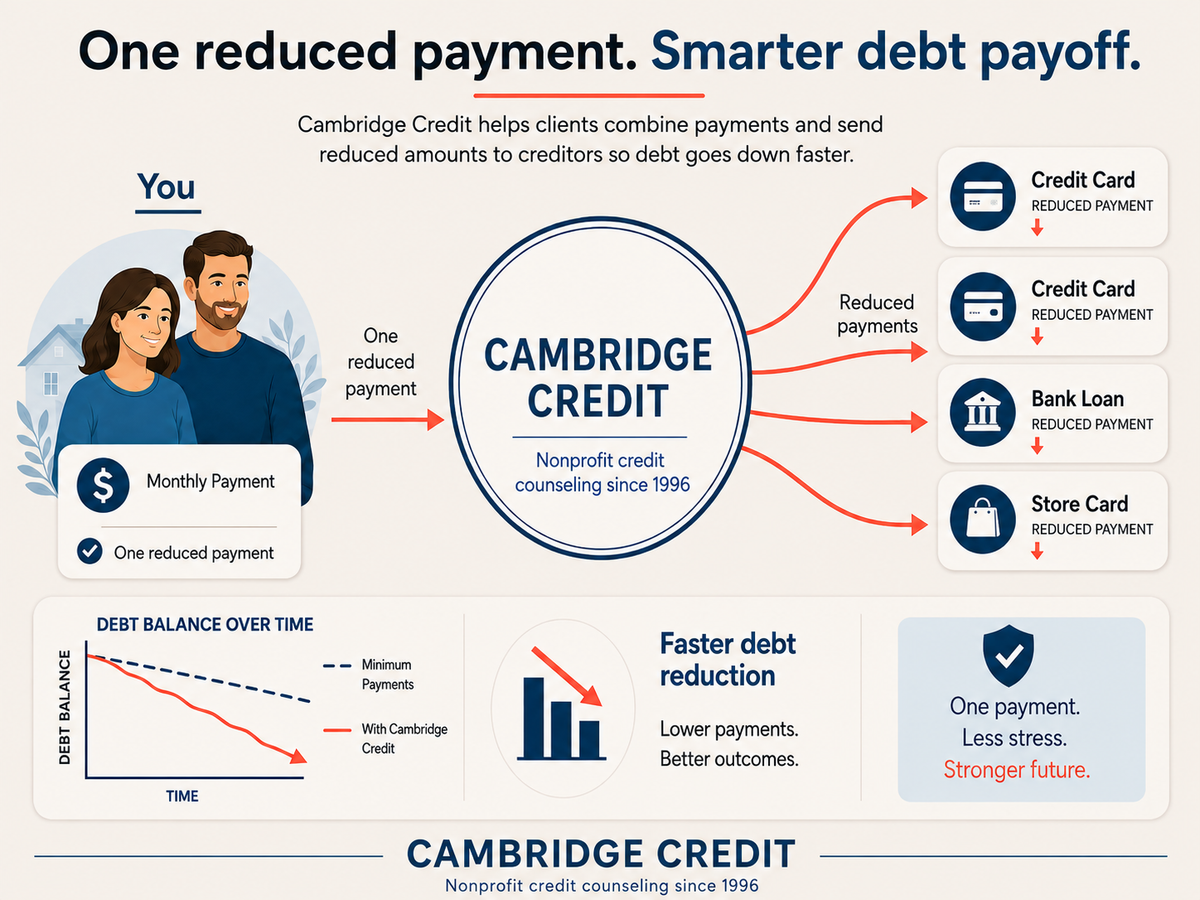
- Interest paidOur typical client would have paid $44,676 in interest on their own, against $4,936 in interest and our fees on the plan
- Interest ratesCreditors cut them from 28.99% to 7% on average
- Monthly payment35.7% lower on average, or 31.1% after our fees
- Time to pay off38 months on average, against a 52-month plan
Cambridge Credit Counseling client data: 6,809 enrollments in the year to 30 June 2026, and 1,434 plan completions in 2025. Prepared by Brian Vosburgh, Director of DMP Operations, September 2026.
Your own result depends on your debts, your budget and what your creditors agree to.
Common questions
How long can I keep my health insurance after losing my job?
Under COBRA, a 1986 federal law, you can continue your former employer's group health plan for up to 18 months, but you pay the premium yourself.
What happens to my 401(k) loan if I lose my job?
If you have an outstanding 401(k) loan, you generally must repay it before your last day on the job or within about 90 days, or the amount becomes taxable and may face a 10 percent early withdrawal penalty if you are under age 59.5.
Does mortgage forbearance erase what I owe?
No. Forbearance is short term relief that may lower your payments for a while, but it does not cancel the debt you owe on your mortgage.
Can anyone get WIC food assistance after a job loss?
WIC is limited to lower income women who are pregnant, nursing, or who have children under age five, so not every household will qualify.
What can I do if my home is already facing foreclosure?
Options include selling the home, a short sale where the home is sold for less than the amount owed with bank approval, or a deed in lieu of foreclosure where you give the property back to the lender.
Where this information comes from
- Equal Credit Opportunity Act | Cambridge Credit cambridge-credit.org Checked 2026-08-25.
- What is a 401k? | Cambridge Credit cambridge-credit.org Checked 2026-08-04.
- Federal Family Education Loans (FFEL) | Cambridge Credit cambridge-credit.org Checked 2026-08-04.
- How to Deal with Layoffs and Income Reductions | Cambridge Credit cambridge-credit.org Checked 2026-08-04.
- Advice If You Don't Need a DMP | Cambridge Credit cambridge-credit.org Checked 2026-08-04.
- Energy Efficiency Tips | Cambridge Credit cambridge-credit.org Checked 2026-08-04.
- Winterizing Your Home | Cambridge Credit cambridge-credit.org Checked 2026-08-04.
- Shopping for a Home | Cambridge Credit cambridge-credit.org Checked 2026-08-04.
- How to Prevent a Foreclosure | Cambridge Credit cambridge-credit.org Checked 2026-08-04.
- Health Education Assistance Loan | Cambridge Credit cambridge-credit.org Checked 2026-08-04.
- Mortgage Downpayments| Cambridge Credit cambridge-credit.org Checked 2026-08-04.
- Mortgage Modification | Cambridge Credit cambridge-credit.org Checked 2026-08-04.
- Student Loan Debt Consolidation | Cambridge Credit cambridge-credit.org Checked 2026-08-04.
- Debt-to-Income Ratio | Cambridge Credit cambridge-credit.org Checked 2026-08-25.
- Cambridge Credit Counseling, confirmed by President and CEO Christopher Viale in August 2026. Checked 2026-08-24.
- What is a Reverse Mortgage? | Cambridge Credit cambridge-credit.org Checked 2026-08-04.
- Cambridge Credit Counseling, Marketing Advertisements Source Data, prepared by Brian Vosburgh, Director of DMP Operations, 1 September 2026. Checked 2026-09-02.